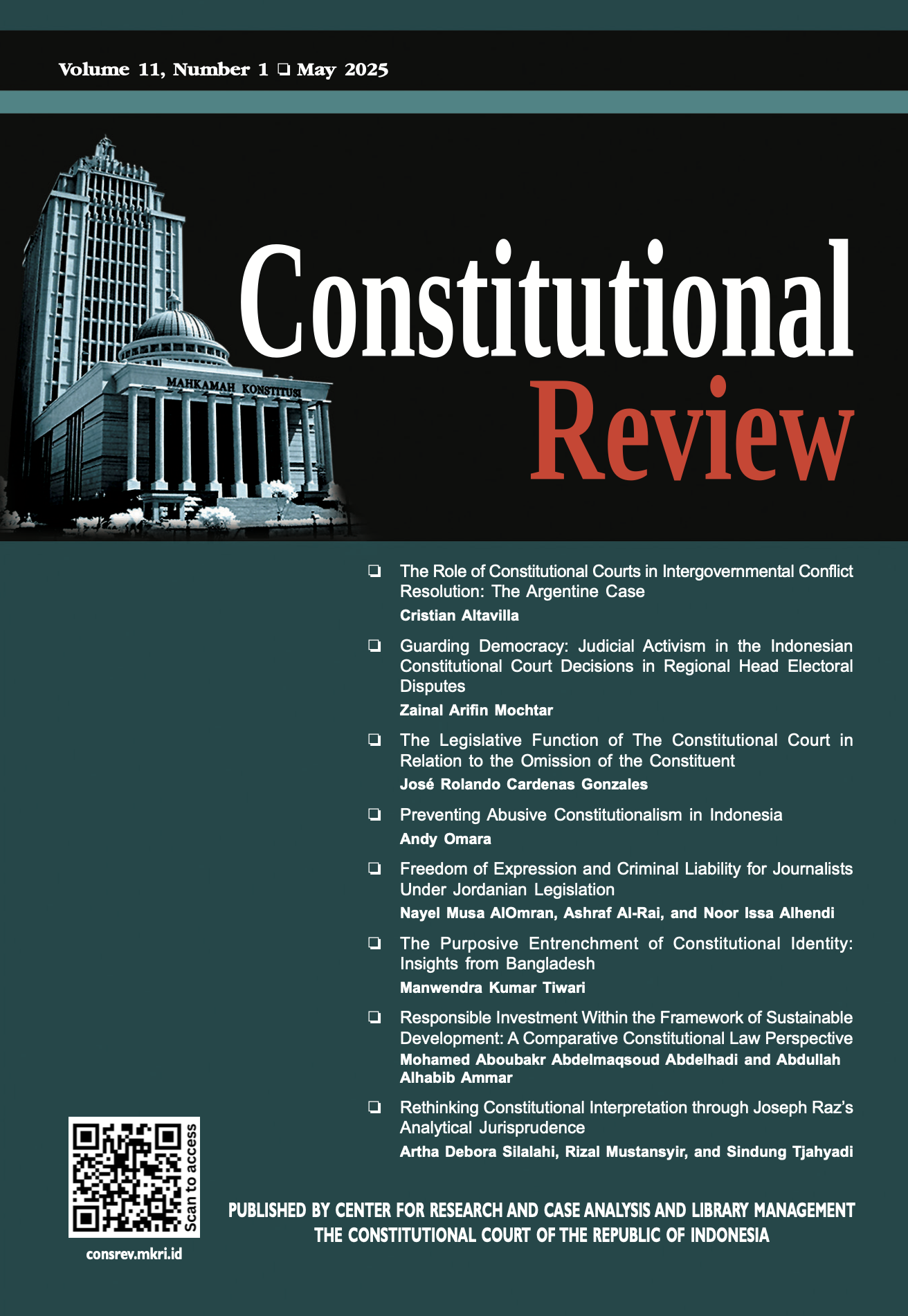
The Purposive Entrenchment of Constitutional Identity: Insights from Bangladesh
DOI:
https://doi.org/10.31078/consrev1116Keywords:
Bangladesh, Basic Structure, Constitutional Amendment, Constitutional Identity, Eternity Clause, SupermajorityAbstract
The judicial review of a constitutional amendment and a constitutional amendment articulating the unamendable basic structures of the Constitution in the form of eternity clauses are fraught with the possibility of debilitating a polity. The lure of making aspirational normative ideals permanent often drives the judicial articulation of constitutional identity in the form of basic structure of the Constitution. On the other hand, the legislature may also wish to articulate the same through the constitutional amendments. This paper highlights the fallouts of such judicial and legislative articulation of constitutional identity in the form of the unamendable basic structures of the Constitution. The paper spotlights Bangladesh and the manner of declaration of unconstitutionality of the 13th constitutional amendment by the appellate division of the Bangladesh Supreme Court and argues that it was a flawed decision. The paper asserts that an indigenous and ethnographic articulation of constitutional identity by the constitutional court better serves a polity than simply aping such an articulation from the neighbouring country. The paper also problematises the popular understanding in the comparative constitutional law about the need of supermajority of a Constitution Court in declaring a constitutional amendment, unconstitutional. The need of supermajority is considered suitable in well-functioning democracies only. It is argued that the simple majority of the Court declaring a constitutional amendment unconstitutional may not be desirable in not so well-functioning democracies like Bangladesh. It further argues that the declaration of the unamendable eternity clause by the 15th constitutional amendment of Bangladesh is an unconstitutional constitutional amendment as it takes away the power of judicial review in respect of the identified eternity clauses and strips the future Parliament of its democratic power to amend the Constitution in respect of the provisions of the Constitution declared permanent by the eternity clause.
References
Abdel Majeed, Laila. Freedom of the Press and Expression in the Arab Countries: In Light of Journalism Legislation, Reality, and Hopes for the Future. Amman: Salman Arar Award, 2002.
Ahmed, Kawser. “Revisiting Judicial Review of Constitutional Amendments in Bangladesh: Article 7B, the Assaduzzaman Case, and the Fall of the Basic Structure Doctrine.” Israel Law Review 56 (January 2023): 263–87. https://doi.org/10.1017/S0021223721000297.
Albert, Richard. “Constitutional Amendment and Dismemberment.” Yale Journal of International Law 43, no. 1 (January 2018): 1.
Baidhowah, Adfin Rochmad. “Defender of Democracy: The Role of Indonesian Constitutional Court in Preventing Rapid Democratic Backsliding.” Constitutional Review 7, no. 1 (January 2021): 124. https://doi.org/10.31078/consrev715.
Baxi, Upendra. “A Known but an Indifferent Judge: Situating Ronald Dworkin in Contemporary Indian Jurisprudence.” International Journal of Constitutional Law 1, no. 4 (October 2003): 557–89. https://doi.org/10.1093/icon/1.4.557.
Beshara, Christopher J. “Basic Structure Doctrines and the Problem of Democratic Subversion: Notes from India.” Law and Politics in Africa, Asia and Latin America 48, no. 2 (June 2015): 99.
Bhardwaj, Sanjay K. “Contesting Identities in Bangladesh: A Study of Secular and Religious Frontiers.” Asia Research Centre Working Paper, LSE no. 36, 2011.
Castillo-Ortiz, Pablo. “The Dilemmas of Constitutional Courts and the Case for a New Design of Kelsenian Institutions.” Law and Philosophy 39 (March 2020): 617.
Caviedes, Cristóbal. “A Core Case for Supermajority Rules in Constitutional Adjudication.” International Journal of Constitutional Law 20, no. 3 (October 2022): 1162.
Caviedes, Cristóbal. “Is Majority Rule Justified in Constitutional Adjudication?” Oxford Journal of Legal Studies 41, no. 2 (Summer 2021): 376–406. https://doi.org/10.1093/ojls/gqaa055.
Chandra, Aparna. “A Precious Heritage?: The Construction of Constitutional Identity by Indian Courts.” Comparative Constitutional Studies 1, no. 1 (June 2023): 140. https://doi.org/10.4337/ccs.2023.0009.
Collier, David, Fernando Daniel Hidalgo, and Andra Olivia Maciucean. “Essentially Contested Concepts: Debates and Applications.” Journal of Political Ideologies 11, no. 3 (October 2006): 211–32.
Ghosh, Saikot Chandra. “Conceptualizing Student Movements in Bangladesh Post-2013: A Qualitative and Comparative Case Study of the Quota Reform Movement and the Road Safety Movement.” Social Identities 29, no. 6
(February 2024): 534. https://doi.org/10.1080/13504630.2024.2320093.
Ginsburg, Tom. “Constitutionalism: East Asian Antecedents.” Chicago-Kent Law Review 88 (January 2012): 11–34.
Hein, Michael. “Do Constitutional Entrenchment Clauses Matter? Constitutional Review of Constitutional Amendments in Europe.” International Journal of Constitutional Law 18, no. 1 (January 2020): 78–101.
Hoque, Ridwanul. “The Evolution of the Basic Structure Doctrine in Bangladesh: Reflections on Dr. Kamal Hossain’s Unique Contribution.” The Indian Journal of Constitutional Law 10 (2023): 44–62.
Hoque, Ridwanul. “The Judicialization of Politics in Bangladesh: Pragmatism, Legitimacy, and Consequences.” In Unstable Constitutionalism: Law and Politics in South Asia, edited by Mark Tushnet and Madhav Khosla. Cambridge: Cambridge University Press, 2015.
Jackman, David. “Students, Movements, and the Threat to Authoritarianism in Bangladesh.” Contemporary South Asia 29, no. 2 (April 2021): 181–200.
Jain, Anmol. “50 Years of Kesavananda Bharti.” VerfassungsBlog, May 11, 2024.
https://verfassungsblog.de/50-years-of-kesavananda-bharti/.
Jacobsohn, Gary. “Constitutional Identity.” Review of Politics 68 (June 2006):361–89. https://doi.org/10.1017/S0034670506000192.
Jacobsohn, Gary. “Theorising the Constitutional Revolution.” Journal of Law and Courts 2 (Spring 2014): 1–28.
Kabir, M. G. “Religion, Language and Nationalism in Bangladesh.” Journal of Contemporary Asia 17 (January 1987): 473–90.
Khan, Adeeba Aziz. “The Politics of Constitutional Amendments in Bangladesh: The Case of the Non-Political Caretaker Government.” International Review of Law (July 2015). https://qspace.qu.edu.qa/handle/10576/3882.
Khan, Maimul Ahsan. “Constitutional Disaster & ‘Legal’ Impunity: Constitutional Amendments in Perspective.” Counsel Law Journal 2, no. 1 (June 2014): 31–82.
Khosla, Madhav. “Inclusive Constitutional Comparative: Reflections on India’s Sodomy Decision.” American Journal of Comparative Law 59, no. 4 (October 2011): 909–36.
Khosla, Madhav. “The Ninth Schedule Decision: Time to Define the Constitution’s
Basic Structure.” Economic and Political Weekly 42, no. 31 (August 2007): 3203–6.
Leon, Mauro Arturo Livera. “Control and Paralysis? A Context-Sensitive Analysis of Objections to Supermajorities in Constitutional Adjudication.” International Journal of Constitutional Law 22, no. 1 (January 2024): 134–56.
Levinson, Sanford. Constitutional Faith. Princeton: Princeton University Press, 1988.
Maîtrot, Mathilde, and David Jackman. “Discipline, Development, and Duress: The Art of Winning an Election in Bangladesh.” Critical Asian Studies 55, no. 3 (July 2023): 424–49. https://doi.org/10.1080/14672715.2023.2229363.
Mostofa, Shafi Md., and D. B. Subedi. “Rise of Competitive Authoritarianism in Bangladesh.” Politics & Religion 14, no. 3 (September 2021): 431–55. https://doi.org/10.1017/S1755048320000401.
Murshid, Tazeen M. “Bangladesh: The Challenge of Democracy—Language, Culture and Political Identity.” Contemporary South Asia 2, no. 1 (1993):67–85. https://doi.org/10.1080/09584939308719703.
Nandy, Ashish. “The Politics of Secularism and the Recovery of Religious Tolerance.” In Secularism and Its Critics, edited by Rajeev Bhargava, 321–44.
Delhi: Oxford University Press, 1998.
OHCHR. “Bangladesh: A Secular State with a State Religion?” 2015. https://www.ohchr.org/en/press-releases/2015/09/bangladesh-secular-state-state-religion.
Powell, H. Jefferson. “The Original Understanding of Original Intent.” Harvard Law Review 98, no. 5 (March 1984): 885–920.
Raihan, Selim, François Bourguignon, and Umar Salam, eds. Is the Bangladesh Paradox Sustainable? Cambridge: Cambridge University Press, 2024.
Riaz, Ali, and Saimum Parvez. “Anatomy of a Rigged Election in a Hybrid Regime: The Lessons from Bangladesh.” Democratization 28, no. 4 (May 2021): 801–24. https://doi.org/10.1080/13510347.2020.1867110.
Riaz, Ali. “The Pathway of Democratic Backsliding in Bangladesh.” Democratization 28, no. 1 (January 2021): 179–98. https://doi.org/10.1080/13510347.2020.1818069.
Roznai, Yaniv. “Introduction: Constitutional Courts in a 100-Year Perspective and a Proposal for a Hybrid Model of Judicial Review.” Vienna Journal on International Constitutional Law 14, no. 4 (January 2021): 355–75.
Roznai, Yaniv. “The Basic Structure Doctrine Arrives in Kenya: Winds of Change for Constitutionalism in Africa?” VerfassungsBlog, May 14, 2023. https://verfassungsblog.de/the-basic-structure-doctrine-arrives-in-kenya/.
Roznai, Yaniv. Unconstitutional Constitutional Amendments: The Limits of Amendment Powers. Oxford: Oxford University Press, 2017.
Satrio, Abdurrachman. “Restoring Indonesia’s (Un)Constitutional Amendments: Soepomo’s Authoritarian Constitution.” German Law Journal 24, no. 2 (Macrh 2023): 402–25. https://doi.org/10.1017/glj.2023.16.
Scheppele, Kim Lane. “Constitutional Ethnography: An Introduction.” Law & Society Review 38, no. 3 (September 2004): 389–411.
Sen, Amartya. Identity and Violence: The Illusion of Destiny. New York: W. W. Norton, 2006.
Sethi, Amal. “When Should Courts Invalidate Constitutional Amendments?” Vienna Journal on International Constitutional Law 18, no. 1 (January 2024): 25–47.
Suteu, Silvia. “Introduction: The Rise of Eternity Clauses in Democratic Constitutionalism.” In Eternity Clauses in Democratic Constitutionalism, edited by Silvia Suteu, 1–20. Oxford: Oxford University Press, 2021.
Suteu, Silvia. Eternity Clauses in Democratic Constitutionalism. Oxford: Oxford University Press, 2021.
Takahashi, Kazuyaki. “Why Do We Study Constitutional Laws of Foreign Countries, and Why?” In Defining the Field of Comparative Constitutional Law, edited by Vicki Jackson and Mark Tushnet, 35–71. Delhi: Praeger, 2002.
The Hindu Data Team. “Bangladesh under Sheikh Hasina—Economic Progress but Democratic Regression.” The Hindu, August 6, 2024. https://www.thehindu.com/data/bangladesh-under-sheikh-hasina-economic-progress-but-democratic-regression/article68489039.ece.
Tiwari, Manwendra Kumar. “Law, Politics, and the Erasure of Secular Constitutional Identity of India.” Comparative Constitutional and Administrative Law Journal 7, no. 1 (2022): 18–36.
Tommasini, Nicola. “Judicial Self-Empowerment and Unconstitutional Constitutional Amendments.” International Journal of Constitutional Law 22, no. 1 (January 2024): 161–84. https://doi.org/10.1093/icon/moae009.
Tripathi, Pradyumna K. “Foreign Precedents and Constitutional Law.” Columbia Law Review 57, no. 3 (1957): 319–33.
Versteeg, Mila, Timothy Horley, Abbe Meng, Mauricio Guim, and Marilyn Guirguis. “The Law and Politics of Constitutional Term Limits Evasion.” Columbia Law Review 120, no. 1 (January 2020): 173–248.
Villiers, Bertus de. “Breathing Life into the Constitution: The Transformative Role of Courts to Give a Unique Identity to the Constitution.” Constitutional Review 9, no. 1 (May 2023): 109–30. https://doi.org/10.31078/consrev914.
Weintal, S. “The Challenge of Reconciling Constitutional Eternity Clauses with Popular Sovereignty: Toward Three-Track Democracy in Israel as a Universal Holistic Constitutional System and Theory.” Israel Law Review 44, no. 3 (July 2011): 449–72.
Wilson, James. “Of the Natural Rights of Individuals.” In Collected Works of James Wilson, vol. 2, edited by Kermit L. Hall and Mark David Hall, 1053–56. Indianapolis: Liberty Fund, 2007.
Wohab, Abdul, and Sandro Serpa. “‘Secularism’ or ‘No-Secularism’? A Complex Case of Bangladesh.” Cogent Social Sciences 7, no. 1 (January 2021): 1–15.