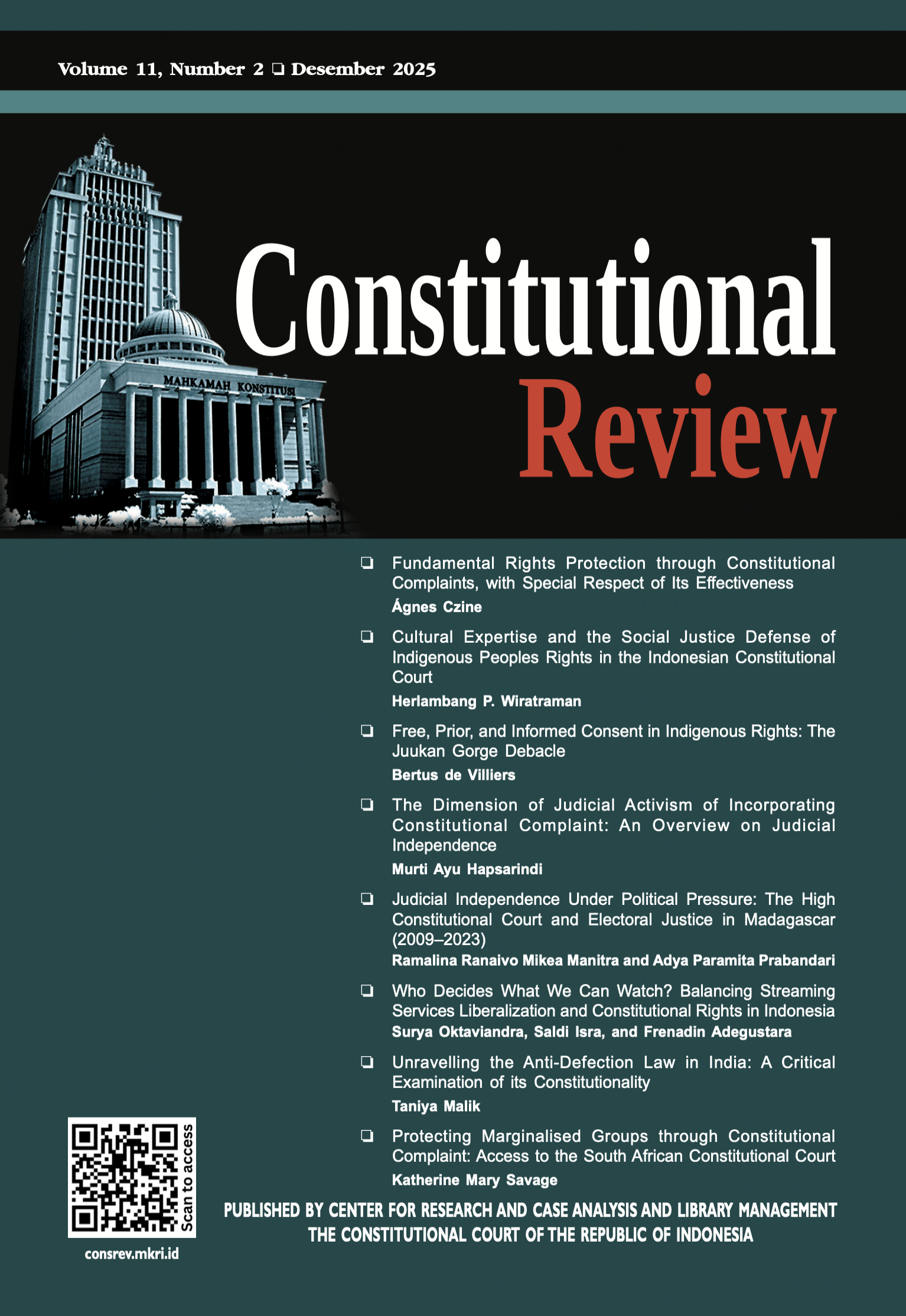
Who Decides What We Can Watch? Balancing Streaming Services Liberalization and Constitutional Rights in Indonesia
DOI:
https://doi.org/10.31078/consrev1126Keywords:
Constitutional rights, Streaming services, Trade liberalizationAbstract
Rapidly growing streaming services have become central to the cross-border circulation of information, cultural, and economic value, which presents complex regulatory challenges for states. This study aims to examine the potential tensions and regulatory interaction between a state’s right to regulate, its commitment to trade liberalization, and citizens’ constitutional rights to access information on the streaming service sector in the context of Indonesia. It offers normative analysis on international trade law, Indonesian constitutional law, and other related disciplines, along with empirical analysis through public surveys to assess public perceptions on protectionist policies. This paper argues that triangular tensions between international laws, states, and citizens occur when a state restricts foreign services. In Indonesia, these tensions are not merely theoretical but are institutionalized through regulations and constitutional court jurisprudence that empower the government to take immediate and repressive measures, including service access restrictions when deemed necessary. In the meantime, empirical research shows that the majority of respondents (83%) demand a high level of freedom to access information, although there is a variety of perceptions and levels of support when government restricts access to foreign streaming services. This means that formulating regulations in this sector requires a careful and comprehensive approach, as the state is obligated to allow streaming services through liberalization and guarantee citizens’ rights to access them in line with its policy objectives and measures.
References
Ayres, Ian, and John Braithwaite. Responsive Regulation: Transcending the Deregulation Debate. Oxford: Oxford University Press, 1992.
Bhagwati, Jagdish. “US Trade Policy: The Infatuation with FTAs.” Working paper, 1995.
Butt, Simon. “Freedom of Information Law and Its Application in Indonesia: A Preliminary Assessment.” Asian Journal of Comparative Law 9 (2014): 113-54.
Cousy, Herman. “The Precautionary Principle: A Status Quaestionis.” The Geneva Papers on Risk and Insurance-Issues and Practice 21 (1996): 158-69.
Dedovic, Stefan, and Vincent Homburg. “Cross-Border Digital Public Services in the European Union: A Systematic Literature Review.” International Journal of Electronic Governance 16, no. 1 (2024): 4-28.
Draper, Nora A. “From Privacy Pragmatist to Privacy Resigned: Challenging Narratives of Rational Choice in Digital Privacy Debates.” Policy and Internet 9, no. 2 (2017): 232-51.
Graham, Janice. “Smart Regulation: Will the Government’s Strategy Work?” CMAJ: Canadian Medical Association Journal 173 (2005): 1469-70. https://doi.org/10.1503/cmaj.050424.
Halpern, David, and Michael Sanders. “Nudging by Government: Progress, Impact, & Lessons Learned.” Behavioral Science & Policy 2, no. 2 (2016): 53-65.
Hennig-Thurau, Thorsten, Victor Henning, Henrik Sattler, Felix Eggers, and Mark B. Houston. “The Last Picture Show? Timing and Order of Movie Distribution Channels.” Journal of Marketing 71, no. 4 (2007): 63-83.
Hill, David T., and Krishna Sen. “The Internet in Indonesia’s New Democracy.” In Democratization, 119-36. London: Frank Cass Publishers, 2000.
Hirschl, Ran. Towards Juristocracy: The Origins and Consequences of the New Constitutionalism. Cambridge, MA: Harvard University Press, 2009.
Hood, Christopher, Henry Rothstein, Robert Baldwin, Judith Rees, and Michael Spackman. “Where Risk Society Meets the Regulatory State: Exploring Variations in Risk Regulation Regimes.” Risk Management 1, no. 1 (1999): 21-34.
Klare, Karl E. “Judicial Deradicalization of the Wagner Act and the Origins of Modern Legal Consciousness, 1937-1941.” Minnesota Law Review 62 (1977): 265-339.
Krehbiel, Jay N. “Public Awareness and the Behavior of Unpopular Courts.” British Journal of Political Science 51, no. 4 (2021): 1601-19.
Kwak, Dongchul, and Minjung Kim. “Trade Negotiations in the Digital Era: The Case of OTT Video Streaming Services.” Global Policy 11 (2020): 14-22.
Ledford, Kenneth F. “Formalizing the Rule of Law in Prussia: The Supreme Administrative Law Court, 1876–1914.” Central European History 37, no. 2 (2004): 203-24.
Leroux, Eric H. “Twenty Years of GATS Case Law: Does It Taste Like a Good Wine?” In Research Handbook on Trade in Services, 2016. https://doi.org/10.4337/9781783478064.00015.
Lim, Hoe. “Trade and Human Rights: What’s at Issue?” Journal of World Trade 35, no. 2 (2001).
Mattoo, Aaditya, Robert M. Stern, and Gianni Zanini. A Handbook of International Trade in Services. Oxford: Oxford University Press, 2007.
Peng, Shin-yi. “GATS and the Over-the-Top Services: A Legal Outlook.” Journal of World Trade 50, no. 1 (2016).
Podgorecki, Adam. “Legal Consciousness as a Research Problem.” In European Yearbook in Law and Sociology 1977, 85-97. Berlin: Springer, 1977.
Pykett, Jessica, Michael Saward, and Anja Schaefer. “Framing the Good Citizen.” The British Journal of Politics and International Relations 12, no. 4 (2010): 523-38.
Rossignol, Nicolas, Pierre Delvenne, and Catrinel Turcanu. “Rethinking Vulnerability Analysis and Governance with Emphasis on a Participatory Approach.” In Risk Analysis, 129–41. Oxford: Blackwell Publishing Inc., 2015.
Satriawan, Iwan, Tareq Muhammad, Aziz Elven, and Tanto Lailam. “Internet Shutdown in Indonesia: An Appropriate Response or a Threat to Human Rights?” Working paper, 2023.
Secretariat, WTO. Guide to the GATS: An Overview of Issues for Further Liberalization of Trade in Services. The Hague: Kluwer Law International, 2000.
Shadikhodjaev, Sherzod. “Technological Neutrality and Regulation of Digital Trade: How Far Can We Go?” European Journal of International Law 32, no. 4 (2021): 1221-47.
Tian, Xin, Jiayi Zhu, Xuan Zhao, and Junfeng Wu. “Improving Operational Efficiency through Blockchain: Evidence from a Field Experiment in Cross-Border Trade.” Production Planning & Control 35, no. 9 (2024): 1009-24.
Ventouratou, Anna. “Justifying Trade Sanctions: Exceptions and Defences under WTO Law.” Cornell International Law Journal 57 (2024).
Zhu, Kevin. “Internet-Based Distribution of Digital Videos: The Economic Impacts of Digitization on the Motion Picture Industry.” Electronic Markets 11, no. 4 (2001): 273-80.